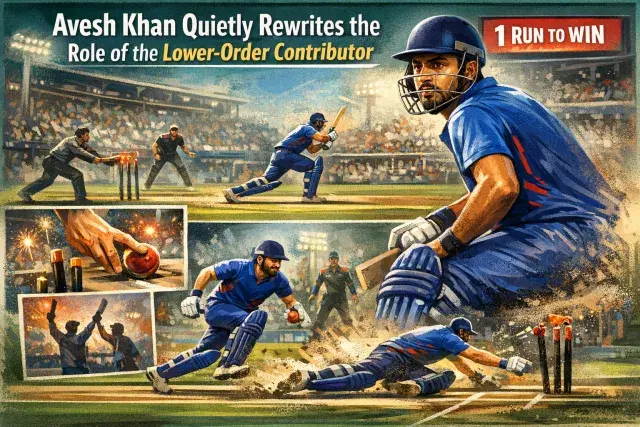

Three times in high-pressure IPL finishes — across 2023, 2024, and 2026 — Avesh Khan was the last man standing when one run separated his side from victory. He scored almost nothing. He faced almost nothing. And yet, each time, his presence and composure at the non-striker's end proved to be the decisive factor. It is a pattern too consistent to dismiss as coincidence.
The Unusual Value of the Non-Striking End
Cricket has long celebrated the finisher — the batter who arrives at the crease with ten needed from six balls and clears the boundary with something to spare. But a quieter and arguably rarer skill exists just beyond that spotlight: the ability to hold one's nerve without doing anything spectacular at all. Avesh Khan has demonstrated this across three separate occasions, each time for a different reason and in a different context.
In the 2023 RCB versus LSG encounter at Chinnaswamy, LSG were chasing a formidable 212 and had clawed their way back through half-centuries from Marcus Stoinis and Nicholas Pooran. With one run needed off the final delivery, Harshal Patel attempted a run-out from the non-striker's end — and missed. Avesh Khan, who had not faced a single legitimate delivery, ran byes to seal the win. His contribution: zero off zero.
The 2024 RR versus KKR encounter told a similar story. Jos Buttler had anchored a brutal chase of 223 — a total built largely on Sunil Narine's century — and needed one off one to win. Buttler found the leg side. Avesh Khan, again at the non-striker's end, ran the winning single. He had not faced a ball in that entire innings. The run was his. The credit went elsewhere.
IPL 2026 and a Slight Variation on the Theme
The LSG versus KKR fixture at Eden Gardens in 2026 introduced a minor adjustment to the formula. KKR had posted 181, a target that proved more troublesome than expected as LSG's top order disappointed. Mukul Choudhary and Ayush Badoni steadied the innings at a critical point, but it came down to the final ball once again. Mukul missed the delivery. Avesh, standing at the other end, ran quickly to beat the throw and complete the winning run.
This time, Avesh actually contributed the run himself — a single off his legs, earned through speed and decisive running rather than any stroke of the bat. It was the most active version of his now-familiar role. Across all three occasions, the throughline is the same: composure under extreme pressure, situational awareness, and the physical readiness to act without hesitation.
What This Pattern Reveals About Lower-Order Craft
The lower-order contributor in high-pressure finishes is underanalysed. Most discussion centres on batting averages, strike rates, and boundary counts. Very little attention is paid to running between the wickets, awareness of field placements in the final over, or the psychological discipline required to remain calm while not being the primary actor in a decisive moment.
Avesh Khan's repeated appearances in these moments are not accidental. He is a pace bowler who has developed a reputation for taking wickets in the middle and death overs — his removal of Phil Salt and Andre Russell in the 2024 KKR innings being one example. That he also possesses the composure to operate effectively at the batting end, even in a passive role, speaks to a kind of cricket intelligence that does not show up clearly on a scorecard.
The broader implication is worth considering: in a format where margins are so fine that a single run — run rather than struck — can determine an outcome, the non-striking batter's awareness and athleticism carry real consequence. Avesh Khan has turned that consequence into something approaching a quiet speciality.
A Legacy Built Without a Bat in Hand
Three wins. One run faced. A handful of runs contributed through running. This is an unusual legacy, but a genuine one. The instances span different years, different franchises in the case of the 2024 Rajasthan Royals appearance, and different opponents. The consistency is striking precisely because the role required is so passive on the surface and so demanding underneath.
Whether Avesh Khan's record in these final-ball situations becomes a more widely discussed aspect of his career depends partly on how often these moments arise. What is already clear is that his contribution to three separate victories cannot be reduced to mere presence. He was in the right place, moving at the right moment, with enough awareness to convert proximity into victory. In the tightest possible margins, that is everything.