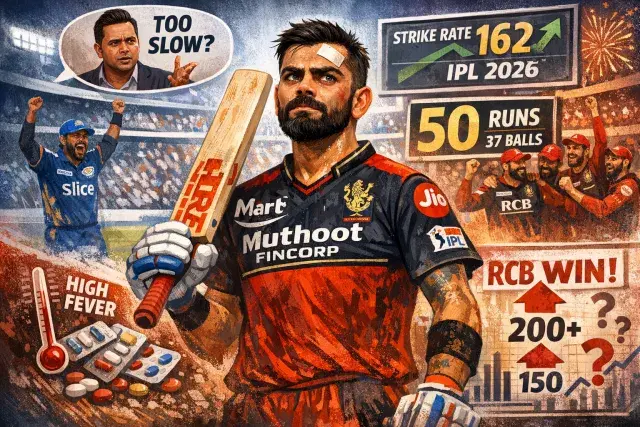
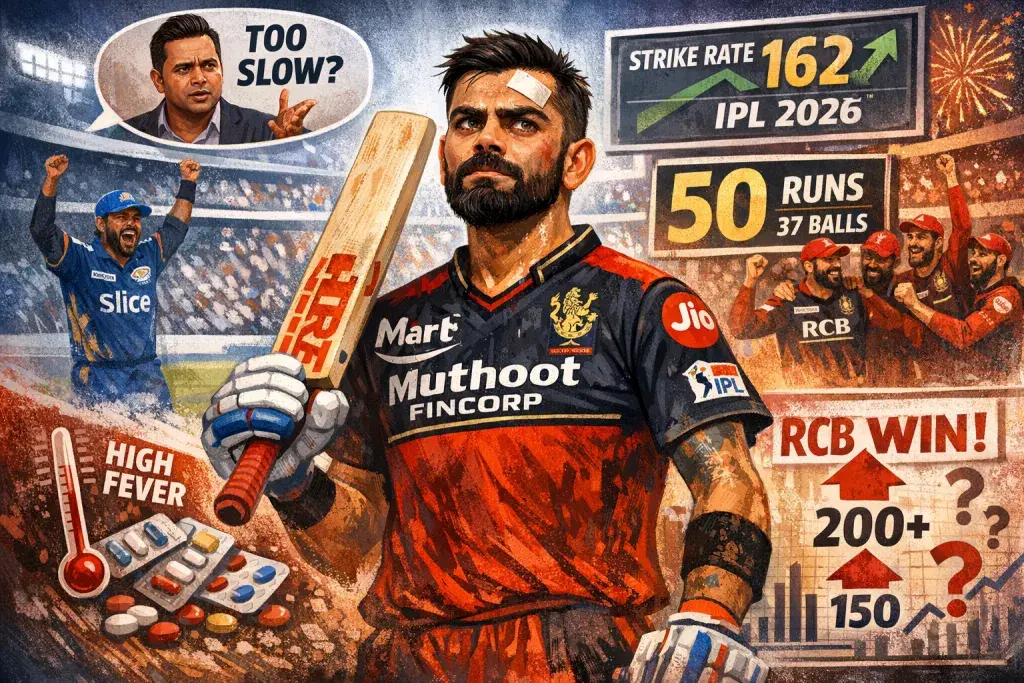
A half-century completed in 37 deliveries can read as a contribution or as a liability depending on the context surrounding it. For Virat Kohli, batting against Mumbai Indians in IPL 2026, it became both simultaneously. Royal Challengers Bengaluru secured the victory, but the conversation that followed centred less on the result and more on whether Kohli's approach belongs in the modern short-format game.
When Context Complicates Criticism
Kohli was unwell going into the fixture. A high fever and headache had compromised his physical condition to the extent that he did not take the field during the opposition's innings — a clear signal of how far from full fitness he was. That he batted at all, and that he constructed a fifty, is a fact that deserves weight before any analytical verdict is delivered.
Every other RCB batter who faced deliveries in that innings maintained a strike rate above 200. Kohli did not cross 150. The contrast was sharp enough to invite scrutiny regardless of the final outcome. Performance under illness rarely produces peak output, and the data from this particular innings reflects exactly that. Attributing a measured fifty during a fever to a technical or temperamental flaw misreads causation.
What Aakash Chopra Said — and What He Did Not Say
Broadcaster and former cricketer Aakash Chopra addressed the innings directly, describing it as slow and, in his words, "unbecoming of the contest" and uncharacteristic of Kohli himself. The criticism carries professional credibility and is not unreasonable in isolation. Short-format batting has evolved rapidly, and the expectation placed on top-order batters to maintain aggression throughout an innings is now near-absolute at the elite level.
However, Chopra's framing acknowledged the victory without dismissing the concern. His critique was structural rather than personal — directed at the kind of innings, not at Kohli's worth as a batter. That distinction matters. A slow innings during illness is an aberration. A consistent pattern of measured batting in conditions that demand acceleration would be the more serious concern. One data point does not establish a pattern.
Kohli's Striking Rate in IPL 2026 Suggests a Broader Arc
The broader picture complicates the narrative of decline that some commentators are eager to construct. Kohli has maintained a strike rate of 162 across IPL 2026, a figure that exceeds his performance across previous editions of the competition. That trajectory is meaningful. It indicates a batter who has consciously adapted to the evolving demands of the format — not one resistant to change.
The short-format game has undergone a genuine recalibration over the past several years. Balls-per-boundary ratios and run-per-ball expectations at the top of an order have shifted decisively. Batters who once anchored innings with 130-strike-rate performances are now asked to do more, earlier, with less tolerance for accumulation phases. Kohli, evidently, has responded to that recalibration — his current season figures reflect an awareness of what is now required.
Illness, Performance, and the Limits of Public Accountability
There is a broader question embedded in this discussion that rarely receives adequate attention: how much of a professional's in-performance output should be judged without accounting for their physical condition at the time? In most professional domains, output produced under acute illness is assessed with modified expectations. In elite competitive performance, that latitude is rarely extended publicly.
Kohli did not use his health as a pre-emptive excuse. He batted, he contributed, and his side won. The discomfort he carried into that innings was revealed only through the visible sign of his absence during the opposition's time at the crease. That restraint, ironically, left him open to the full weight of post-performance analysis without the contextual cushion his condition warranted. One measured innings during a fever, set against a season that is statistically his most aggressive in the format, does not constitute cause for sustained concern.