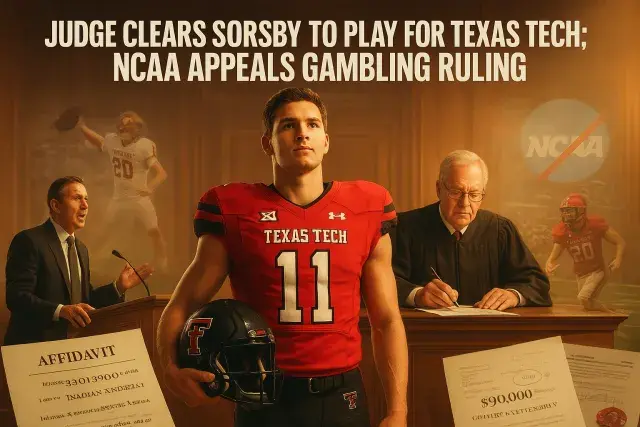
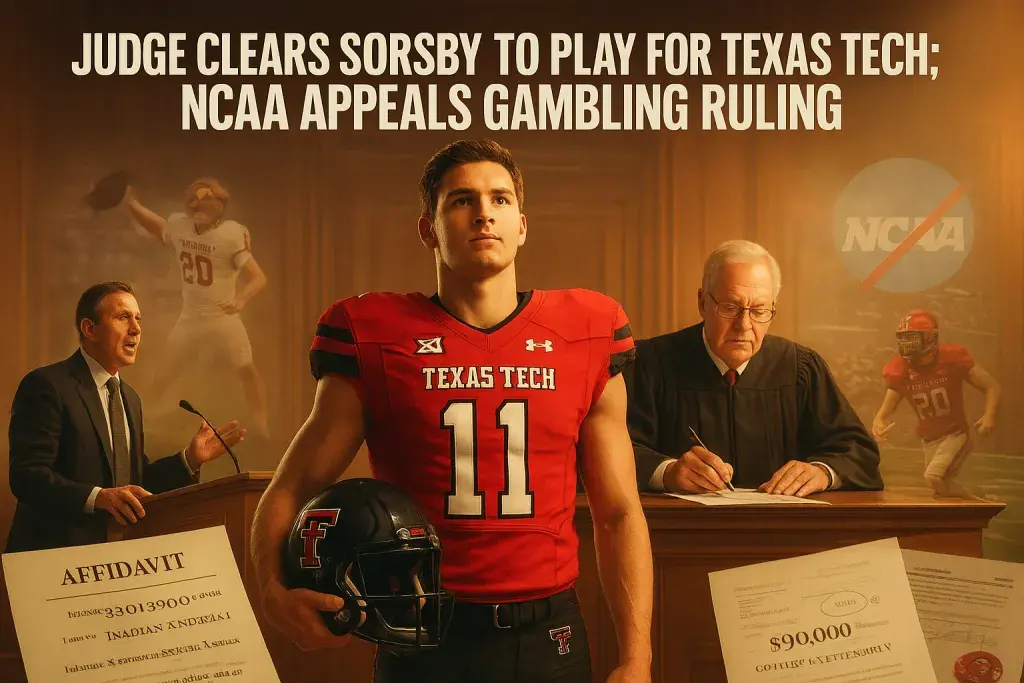
Judge clears Sorsby to play for Texas Tech; NCAA appeals gambling ruling
A Texas district court judge has granted Texas Tech quarterback Brendan Sorsby a temporary injunction allowing him to participate in the 2026 football season, despite his admission to placing thousands of bets - including wagers on his own team - during his time as a college athlete. The NCAA, which had ruled Sorsby permanently ineligible, has since filed an appeal with the 7th District Court of Texas.
Judge Ken Curry, presiding in Lubbock, Texas, issued the injunction after determining that Sorsby would suffer irreparable harm if barred from the upcoming season. "The Court finds that applicant has demonstrated that he will suffer a probable, imminent, and irreparable injury if this court does not issue the temporary injunction because he will be unable to participate as a member of Texas Tech University's 2026 football team," Curry wrote in his order. Under the ruling, the NCAA is prohibited from blocking Sorsby from practicing, playing, or otherwise participating with Texas Tech's program. He will, however, serve a two-game suspension to open the 2026 season - a penalty aligned with a proposal Sorsby's legal team had previously submitted to the NCAA during negotiations.
Sorsby, through a sworn affidavit, admitted to placing at least 2,900 wagers totaling more than $30,000 during his enrollment at Indiana University, beginning with the 2022 season. Of those, 40 bets were placed on Indiana football, though Sorsby was on the scout team at the time and appeared in only one game that season, against Penn State. He also admitted to gambling on Indiana and Cincinnati basketball while enrolled at those schools. His total wagering since enrolling in college reached at least $90,000, according to figures cited in the draft filings. The NCAA opened its investigation after becoming aware of the betting activity, and the governing body's decision to render Sorsby ineligible prompted him to file suit in a Lubbock district court.
Attorney Jeffrey Kessler, arguing on Sorsby's behalf, contended that the quarterback's gambling was a product of a diagnosed mental health disorder and that none of the bets were placed with the intent to compromise competitive integrity. "It is undisputed that he never did any betting to compromise the integrity of his team," Kessler said. "The bets he made on his team was when he was not participating in that team and he never bet again to do that." Kessler framed the NCAA's refusal to accept the two-game suspension proposal as a failure to honor its own stated commitments to supporting student-athletes dealing with gambling addiction. The NCAA has contested that characterization and, in filing its appeal, signaled it intends to challenge both the injunction and the legal precedent the ruling may establish for future eligibility disputes involving gambling violations.