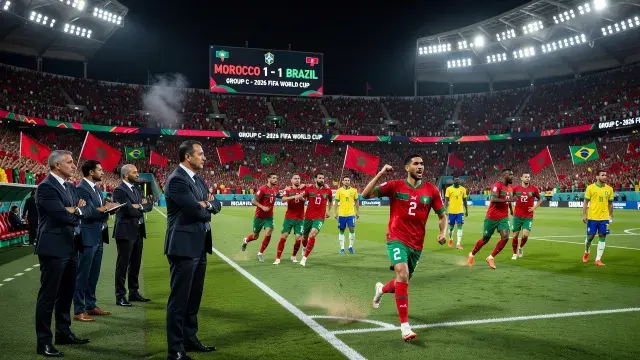
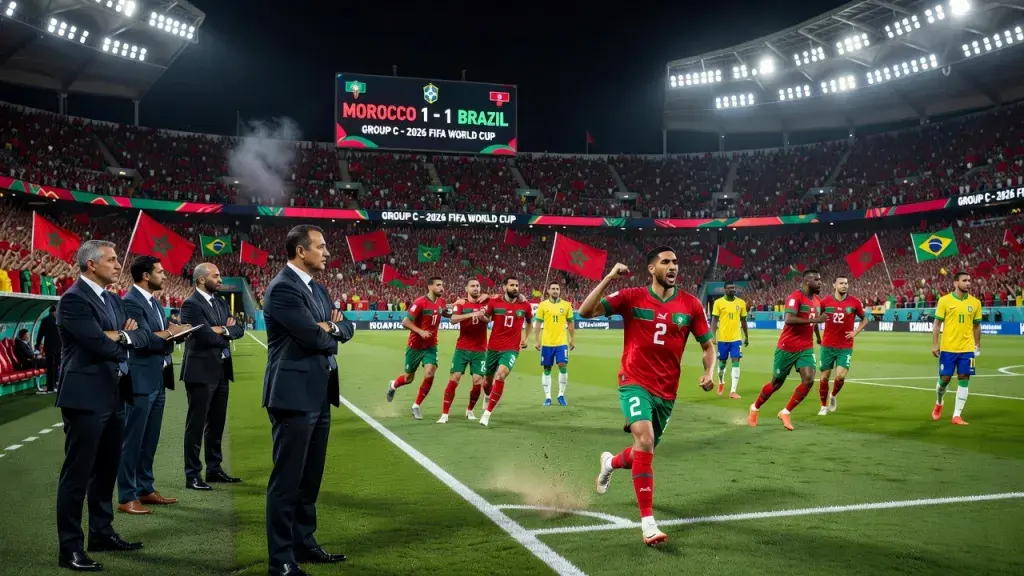
Fewer than a hundred days after dismissing the man who delivered the greatest result in their football history, Morocco opened the 2026 World Cup with a 1-1 draw against Brazil - a result that immediately silenced the sharpest critics of one of the tournament's most audacious coaching decisions. When the Moroccan federation parted ways with Walid Regragui in March and handed the senior job to Mohamed Ouahbi, a coach with no senior management experience, the move was widely read as panic dressed up as boldness. The draw with the five-time champions in Group C suggests it may be something else entirely.
The context around the appointment matters as much as the result itself. Regragui was not a caretaker or a stopgap when he left; he was the architect of Morocco's semi-final run at Qatar 2022, the tournament that made the Atlas Lions the first African and Arab nation to reach the last four of a World Cup. His exit was triggered by a single defeat - a 1-0 loss to Senegal in the Africa Cup of Nations final, played on home soil - and the swiftness of the decision reflected how dramatically expectations had shifted in the years since Doha. Just as fans in diverse sporting markets - whether following football, cricket, or even basketball 3x3 live betting - have learned that momentum can turn on a single result, Morocco's federation demonstrated that even historic achievement offers no guarantee of tenure once a fanbase has recalibrated what it considers acceptable. Regragui gave the country a new ceiling; that ceiling then became the floor he was judged against. basketball 3x3 live betting
The man chosen to replace him, Mohamed Ouahbi, 49, arrived with a curriculum vitae built entirely in the youth ranks. His most recent and most compelling credential was guiding Morocco's under-20 side to a World Cup title - a triumph that made the case for his promotion louder than any CV entry could. Yet the gap between developing teenagers and managing a dressing room of established European club professionals at a senior World Cup is a chasm, and Ouahbi stepped across it without so much as a season at club level in between. The federation addressed that inexperience by building a support structure around him: Joao Sacramento, a former assistant to Jose Mourinho, was brought in alongside Youssouf Hadji, who carries deep familiarity with Moroccan football. The thinking was clear - keep Ouahbi's knowledge of the emerging generation at the core, and surround it with tournament-tested tactical intelligence.
What Brazil Revealed About the New Morocco
Opening against Brazil in Group C, alongside Scotland and Haiti, was the kind of draw that could have derailed a new coaching regime before it found its footing. Morocco did not merely survive the occasion. By most accounts they were the more energetic side in the early exchanges, pressing aggressively and using quick transitions to disorient a Brazilian team that expected space and control. The final 1-1 scoreline flattered neither side unduly; it was a genuine contest between two teams with serious ambitions. For Ouahbi, the point was worth more than its face value. A new coach earns credibility through results faster than through any other means, and a draw against the most decorated nation in World Cup history is a statement that travels well beyond the training ground.
The quality of the squad makes the decision to change coaches defensible in a way it simply would not be with a weaker group of players. Achraf Hakimi, one of the finest attacking full-backs in world football, captains a side packed with players competing at the top of the European game. The spine that reached the Qatar semi-final has matured, supplemented by a new wave of talent - including dual-nationality players who elected to represent Morocco over the European nations available to them. This is a squad with the experience and depth to absorb disruption, and the federation clearly factored that resilience into their calculation when they pulled the trigger on the coaching change so close to the tournament.
The Regragui Shadow and What It Demands
Every call Ouahbi makes over the coming weeks will be refracted through the lens of what his predecessor achieved. Regragui did not simply win matches in Qatar; he changed the narrative around African and Arab football permanently. He knocked out Spain on penalties and eliminated Portugal, and for a brief, extraordinary stretch in November and December 2022, Morocco were the team the neutral world had adopted. The consequence of that run is a fanbase that no longer measures success by group-stage qualification. The expectation now is progression, and sustaining that level - achieving back-to-back group exits as a minimum, and ideally a deep knockout run - is the baseline against which this tournament will be judged.
The senior players in this squad know precisely what the semi-final felt like, and they are unlikely to follow a first-time senior coach on faith alone. The Brazil draw will have done more for Ouahbi's authority in that dressing room than any pre-tournament speech. Players respect results, and the opening point gave him something concrete to build on. There is a harder truth underneath all of this, though. The speed with which Regragui was shown the door after a single tournament defeat serves as a standing reminder to every manager in international football: achievement buys time, not permanence. Ouahbi already knows that the same logic applies to him. If this World Cup goes wrong, the goodwill accumulated in a draw with Brazil will count for very little.
A Verdict Still Forming
Morocco have made the boldest coaching call of this World Cup, and the early evidence tilts marginally in their favour. One result does not settle the argument. Wins against Scotland and Haiti will be expected, and the real test - as it was for Regragui in Qatar - will come when the knockout rounds begin and the margin for error disappears entirely. If Ouahbi navigates this squad into the latter stages, the federation will look prescient for trusting the man who knew the next generation best at precisely the moment they needed to be unleashed. If Morocco stumble and exit early, the questions about why they dismantled something that was still working will be inescapable. The answer is still being written, and the next few weeks will determine whether this was vision or recklessness.