No scoreline in football carries weight quite like a World Cup upset. These are not merely results recorded in a database; they are seismic events that fracture national identities, end managerial careers, and permanently alter how coaches prepare their teams for global competition. From the Cold War tension of a divided Germany to the raw tragedy of Andres Escobar's murder in Medellín, the tournament's most shocking results have echoed far beyond the pitch.
The World Cup's capacity to produce the unexpected is unmatched in sport, and while some fans channel their passion into following every discipline - some even exploring waterpolo online betting during the tournament's quieter days - nothing commands the planet's collective attention like a giant-killing on football's biggest stage. The moments catalogued below did not merely embarrass the favorites; they dismantled certainties, exposed structural failures, and, in several cases, permanently changed how entire continents understood their own footballing potential.
Africa Announces Itself: Cameroon, Senegal, and Algeria Change the Conversation
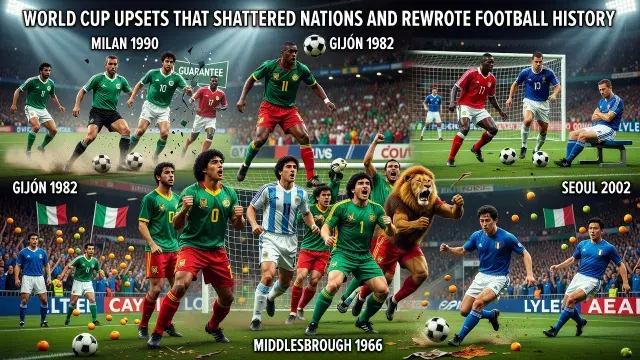
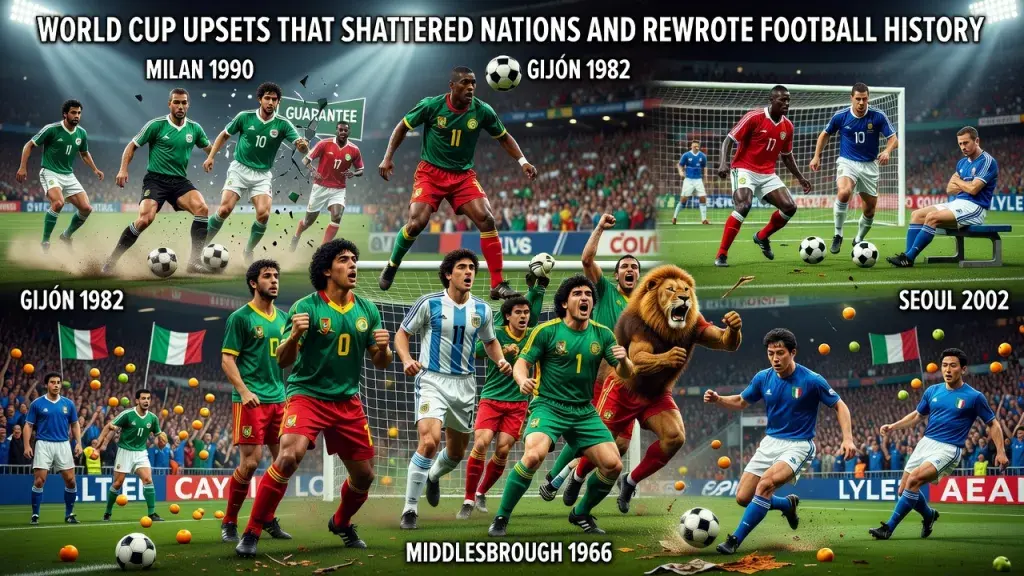
Three results above all others reshaped global perceptions of African football. In Gijón in 1982, Algeria defeated West Germany in one of the tournament's most celebrated upsets, with Rabah Madjer and Lakhdar Belloumi combining to stun a side whose own coach had publicly guaranteed victory. It was the first time an African nation had beaten a European power at the World Cup, and its psychological impact on the continent was incalculable. The clinical discipline Algeria displayed that afternoon planted a seed that grew across subsequent decades.
Eight years later in Milan, Cameroon ambushed defending champions Argentina. Despite finishing with nine men, the Indomitable Lions neutralised Diego Maradona and scored through a François Omam-Biyik header that goalkeeper Nery Pumpido could only fumble into his own net. The victory was physical, confrontational, and completely effective. Cameroon's subsequent run to the quarterfinals permanently elevated Africa's standing in the global game. Then, in Seoul in 2002, Senegal repeated the trick against a far more glamorous victim: France, the reigning world and European champions. Papa Bouba Diop's bundled goal and the celebration that followed became one of the tournament's defining images. France, missing Zinedine Zidane through injury, never recovered, exiting without scoring a single goal. Senegal reached the quarterfinals. The pattern was unmistakable: African teams, when organised and fearless, could dismantle anyone.
The Humiliation of Giants: Germany, Italy, and Spain Fall When It Matters Most
History's heavyweights have suffered some of the tournament's most brutal lessons. Italy's elimination by North Korea in Middlesbrough in 1966 remains arguably the most shocking result the competition has ever produced. Pak Doo-ik's solitary goal sent the Azzurri home to be pelted with fruit by their own supporters - a humiliation so complete it entered sporting folklore. In 2018, Germany arrived in Russia as defending champions and departed in the group stage, beaten by South Korea deep in stoppage time, with Manuel Neuer stranded upfield as Son Heung-min finished into an empty net. The defeat triggered a fundamental restructuring of German football.
Spain's implosion against Nigeria at France '98 exposed the tactical fragility beneath a generation of genuine talent. Goalkeeper Andoni Zubizarreta's catastrophic own goal opened the door, and Sunday Oliseh's thunderous twenty-five-yard strike slammed it shut. The defeat directly caused Spain's early exit. Then, in 2010, France completed perhaps the most dysfunctional group-stage campaign in tournament history: a player mutiny following Nicolas Anelka's expulsion, a refusal to train, and ultimately a defeat to host nation South Africa in Bloemfontein that left them bottom of their group. Yoann Gourcuff was sent off for an elbow, Katlego Mphela scored before halftime, and Les Bleus were finished - a complete institutional collapse played out under the global spotlight.
Saudi Arabia, Costa Rica, and the Tactical Blueprint for Beating Favorites
Two results from more recent tournaments demonstrated that the art of the upset had become increasingly sophisticated. In Recife in 2014, Costa Rica's disciplined offside trap neutralised Andrea Pirlo so comprehensively that Italy never found a way through. Bryan Ruiz's header off the underside of the crossbar just before halftime sealed a victory that allowed the Central Americans to top a group containing Italy, England, and Uruguay - three former world champions. It was tactical precision executed under extraordinary pressure.
In Qatar in 2022, Saudi Arabia deployed a similarly brave approach against Argentina, maintaining a high defensive line that caught Lionel Messi's teammates offside on multiple occasions in the first half. When the second half arrived, Saleh Al-Shehri and Salem Al-Dawsari struck to complete one of the tournament's most stunning reversals. Argentina had arrived on a thirty-six-match unbeaten run; they left that stadium utterly exposed. The fact that Argentina ultimately won the trophy does not diminish the result. If anything, it underscores how fine the margins are at this level - and how a single afternoon of tactical boldness can redefine an entire tournament's narrative.
Records That Haunt: The Heaviest Defeats in World Cup History
Not every upset involves a smaller nation winning. Some of the tournament's most enduring stories are those of one-sided destruction. Hungary's 10-1 demolition of El Salvador in 1982 remains the largest margin of victory the competition has ever recorded. Substitute László Kiss scored a hat-trick in seven minutes, and El Salvador's lone consolation through Luis Ramirez Zapata remains the only World Cup goal the Central American nation has ever scored. Germany's 8-0 defeat of Saudi Arabia in Sapporo in 2002, with Miroslav Klose heading home a hat-trick on his global debut, was a statement of technical dominance that silenced domestic critics and launched a run to the final. Yugoslavia's evisceration of Zaire in 1974 - six goals in Gelsenkirchen against a squad reportedly threatened with punishment by their own government if they conceded further to Brazil - illustrated how political pressure could drain a team of its last reserves of competitive spirit.
Portugal's 7-0 dismantling of North Korea in Cape Town in 2010 carried weight beyond the scoreline. The match was broadcast live inside North Korea itself, making the public collapse of their national team a source of deeply political embarrassment for a government that had brought the squad back to the global stage under enormous ideological pressure. These are the results that do not merely end campaigns - they rewrite the relationship between a nation and its football, sometimes permanently.