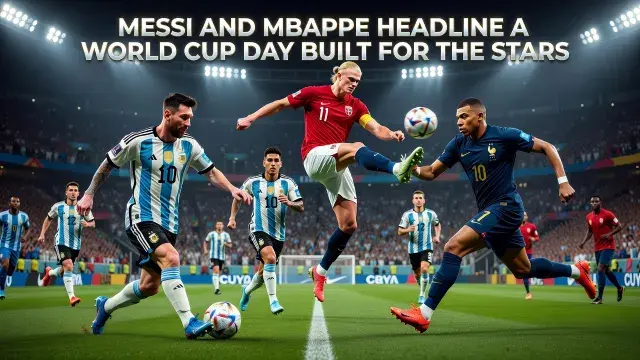
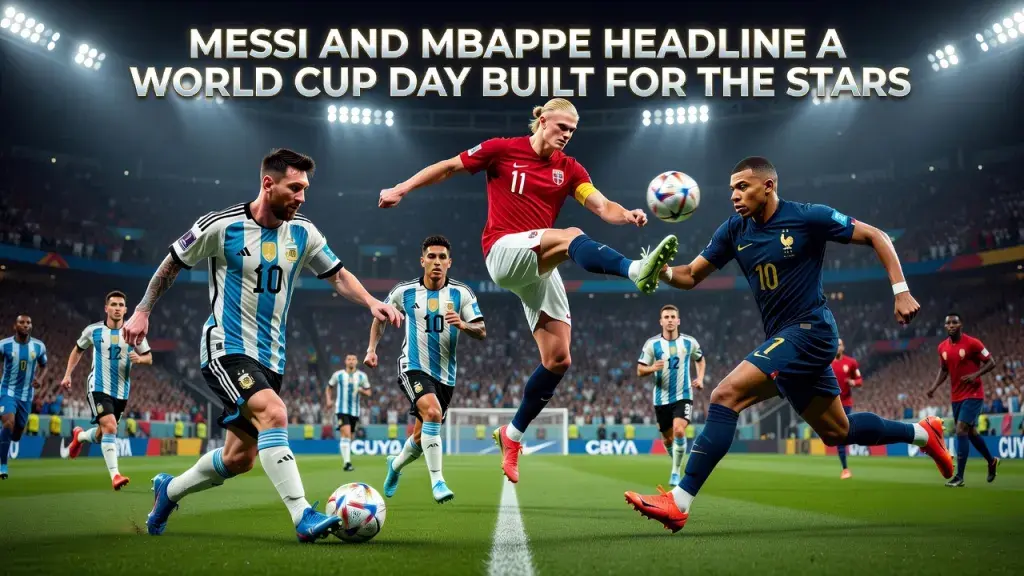
The first round of World Cup group stage fixtures is almost complete, and Thursday delivers its most compelling instalment yet. Argentina, the holders, begin their title defence against Algeria in Group J, a match carrying its own quiet anxiety given how catastrophically their 2022 campaign started before it ultimately ended in triumph in Lusail. But before La Albiceleste step out, Group I offers two fixtures that together read like a tournament organiser's dream: France versus Senegal, a rematch of one of the most seismic upsets in World Cup history, and then Norway, tournament football novices by recent standards, unleashing Erling Haaland on the world stage for the first time.
The occasion is enormous enough that it invites reflection on the broader sweep of the competition, and the contrast between the two men most likely to define it. Lionel Messi, now 38 and three and a half years removed from lifting the trophy in Qatar, arrives at this tournament in circumstances that demand honest appraisal rather than nostalgia. His last two seasons have been spent at Inter Miami, lighting up MLS with a brilliance that, on its own terms, has been genuinely remarkable. The numbers he has posted in North America belong in a different visual register to most of what surrounds him - the kind of statistics that prompt the reaction that, yes, this is still quite clearly silly, and no, you should not be able to do that at this stage of a career. It bears noting that this World Cup, unlike beach volleyball odds markets where the field is narrow and conditions relatively controlled, involves the full complexity of international football at its most pressurised, and the step up from MLS to this stage is real and significant regardless of who is taking it. beach volleyball odds
A league-rating model like Opta's would suggest that MLS, even at its current improved level following the wave of European arrivals this summer, represents a considerably lower competitive ceiling than the top divisions of South America or Europe. The 100th percentile version of Messi in North America may well translate to something in the 93rd or 95th percentile here. That is still, to be clear, an exceptional footballer. Whether it is the Messi who bent a World Cup final to his will, threading passes that television cameras struggled to follow and 21 opposition players could not intercept - that remains the defining question of his participation. The supporting cast is a genuine upgrade on what he has had at club level: Julian Alvarez and Lautaro Martinez offer a quality of target and movement that no MLS defence has been asked to cope with, and the Argentine midfield carries the kind of creative infrastructure to give Messi exactly the platform he needs. The risk, and it is worth naming it plainly, is that this becomes his Michael Jordan at the Washington Wizards moment - a great player, performing at an All-Star level, but no longer at the singular altitude that once separated him from everyone alive.
Mbappe's Defensive Reckoning Arrives on the Biggest Stage
Kylian Mbappe has heard the conversation. He has acknowledged it directly. Forty-two goals and six assists in 43 appearances for Real Madrid last season is a record that the overwhelming majority of forwards in world football would accept without complaint, and yet the persistent and entirely legitimate critique of his game has centred not on what he does with the ball, but on what he conspicuously declines to do without it. Data published by Gradient Sports covering La Liga last season places Mbappe's pressing output at 16.99 total pressures per 90 minutes. The divisional average was 42.08. Marcus Rashford, himself no high-press evangelist, ranked second from bottom in the same sample with 22.51. Vinicius Junior, not widely celebrated for his defensive diligence, pressed at approximately twice Mbappe's rate. Roughly 20 centre-backs applied more pressure per 90 than he did. He registered two interceptions across the entire La Liga campaign - one fewer than Joan Garcia, the Barcelona goalkeeper.
Mbappe's own words before this tournament suggest he understands the stakes. "I need to take the extra step because it's something important for the team and I have to do it," he said. "It will start this time because we want to win, and to win, I'm ready to do whatever because I want to win at all costs." The context matters: when playing for a side as territorially dominant as Real Madrid, or for a France team expected to control Group I possession, a forward's defensive passivity rarely costs the team directly. It is at the margins, in knockout football's tight and contested passages, where that diffidence tends to manifest as a structural problem. Mbappe has one World Cup winner's medal and one runner's-up finish from his two tournaments. He is four goals away from equalling the all-time scoring record at 27 years of age. The platform is there. The question is whether the complete version of Mbappe - the one who has spoken about defending as if he means it this time - actually materialises when France need him in both phases.
France, Senegal, and a Group With Real Historical Weight
The fixture list's sense of occasion is not limited to the individual storylines. France versus Senegal carries genuine historical freight. Their 2002 meeting, the opening game of that World Cup, produced one of the tournament's most celebrated upsets as Senegal, appearing in just their second finals, defeated the reigning world and European champions. The Lions of Teranga have been a transformed football nation since that morning in Seoul, building sustained continental competitiveness and, under Aliou Cissé, claiming the Africa Cup of Nations title - a title which, it should be noted, was subsequently stripped by a CAF ruling conducted in the federation's offices rather than on any pitch. The grievance is real and the motivation is not difficult to identify. Senegal arrive with a squad of considerable Premier League and top-flight European experience, and if the expectation is that France will be dominant, the evidence of 2002, and of the current quality available to Senegal, suggests that nothing about this group is settled.
Haaland's Long Wait and Argentina's Familiar Anxiety
Norway's presence in this tournament ends a wait stretching back to the 1998 World Cup in France, with their last major tournament appearance coming at Euro 2000. Erling Haaland has spent the intervening years becoming one of the most prolific strikers the European game has produced, breaking records at Borussia Dortmund and then at Manchester City with a consistency that has moved beyond remarkable into something approaching routine. This is, however, a different context entirely. International football has not always been the stage on which the most clinical club strikers automatically translate, and Norway's squad, while organised and physically capable, does not carry the same creative infrastructure around Haaland that Pep Guardiola has constructed at club level. It is a fascinating experiment, and it is one the tournament genuinely needs.
Argentina, meanwhile, carry the particular anxiety of holders who know exactly how badly the opening game can go. Their 2022 group stage defeat to Saudi Arabia remains one of the tournament's most startling results of recent memory, a game that seemed for several hours to have ended not just their campaign but the possibility of the narrative conclusion that ultimately arrived. Algeria in Group J represent genuine danger - an experienced, physically robust side with quality in the final third and a point to prove on the continental stage after their own turbulent years. Austria against Jordan in the same group offers a more measured dynamic but is nonetheless a fixture that will shape which side has breathing room by the end of matchday one. The first round is almost done. What a day to finish it.